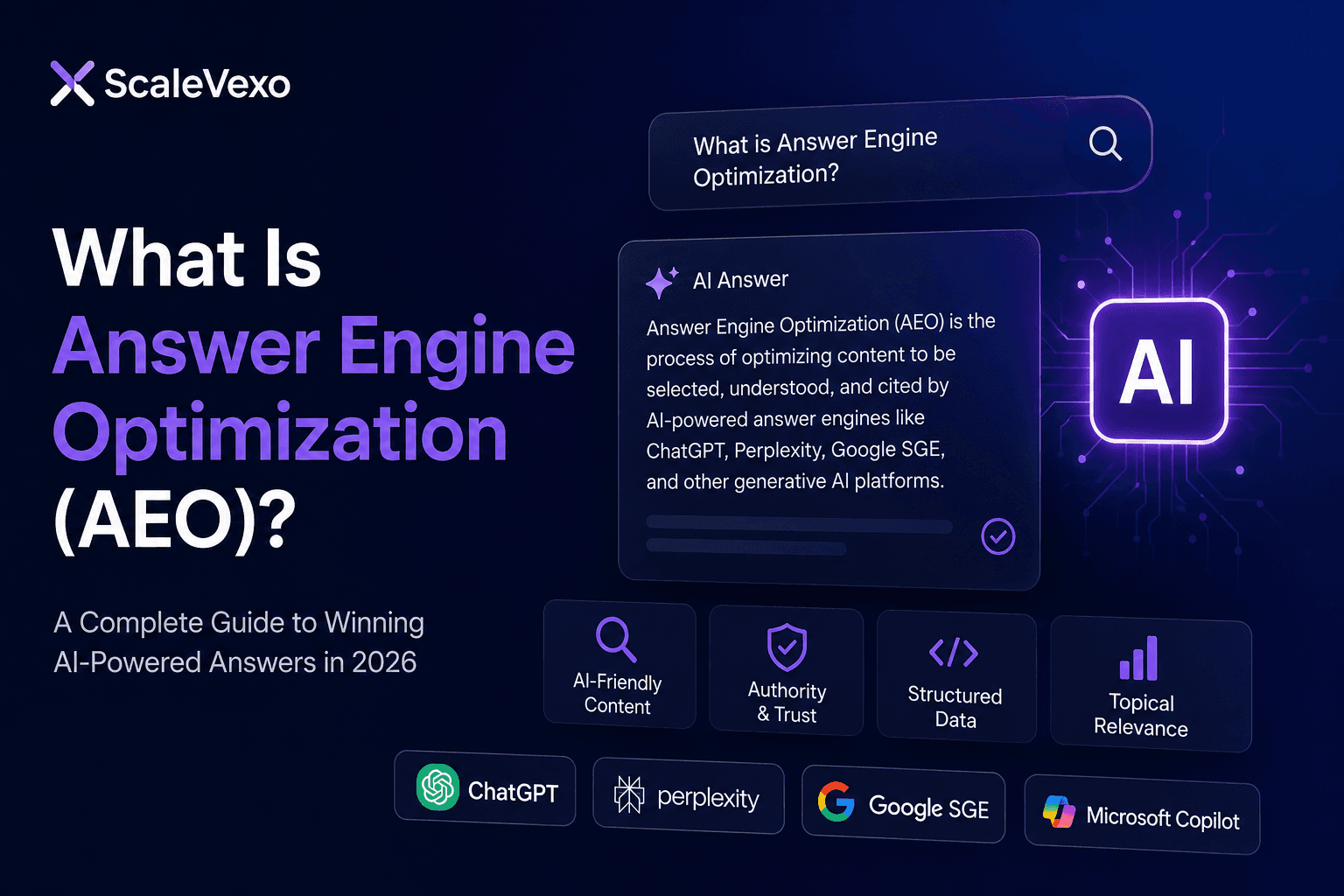
What Is AEO? Get Recommended by ChatGPT & Perplexity in 2026
Answer engine optimization (AEO) is the fastest-growing visibility strategy in digital marketing — and most businesses have never heard of it.Right now, your potential customers are opening ChatGPT, typing "best digital
Verified by ScaleVexo Engineering Panel|Updated 28 Jul 2026
Answer engine optimization (AEO) is the fastest-growing visibility strategy in digital marketing — and most businesses have never heard of it.
Right now, your potential customers are opening ChatGPT, typing "best digital marketing agency for B2B companies," and getting a direct answer with a name, a reason, and a link. No scrolling. No comparing results. Just a recommendation.
That business either showed up or it didn't. If it wasn't yours, you lost a high-intent buyer without knowing they existed.
This is the reality of AI-powered search in 2026. In this complete guide, you'll learn exactly what answer engine optimization is, why it's become essential for business visibility, how it differs from traditional SEO, and the step-by-step tactics to get your brand cited by ChatGPT, Perplexity, and Google AI Overviews — starting today.
What Is Answer Engine Optimization (AEO)?
Answer engine optimization (AEO) is the practice of structuring your content and digital presence so that AI-powered platforms — like ChatGPT, Perplexity, Google AI Overviews, and Microsoft Copilot — select and cite your brand when generating answers to user queries.
If traditional SEO gets your page to rank on Google so users can click through, AEO gets your brand inside the AI-generated answer — before the user has to choose anything at all.
When someone asks Perplexity "what's the best tool for automating a sales pipeline" and your brand appears in the response, that's answer engine optimization working. You're not competing for a click. You're already the recommendation.
AEO is sometimes called generative engine optimization (GEO), and while the two terms overlap, AEO specifically focuses on answer engines — platforms where users ask questions and receive direct, cited answers rather than a list of links.
[Image placeholder: Diagram showing Traditional Search (Google → Results → Click) vs Answer Engine (ChatGPT → Direct Answer with Citation) — Alt text: "Answer engine optimization AEO vs traditional SEO flow diagram"]
Why Answer Engine Optimization Matters More Than Ever in 2026
Let's look at the numbers first, because they tell the story better than anything else.
ChatGPT now handles 2 billion daily queries and has grown to 900 million weekly active users — nearly double what it was 18 months ago. Perplexity processes over 1 billion queries monthly. Google AI Overviews now appear in roughly one in four searches and are still expanding.
Gartner predicted that traditional search engine volume would drop 25% by 2026 as users shifted to AI tools for answers. That prediction is materialising — and in some content categories, the drop is steeper than projected.
But here's what makes these numbers critical for businesses specifically: the queries shifting to AI tools aren't random. They're the high-intent research queries — "what's the best CRM for a growing sales team," "which digital marketing agency handles international SEO," "how do I automate lead follow-up." These are the searches that used to drive your most valuable organic traffic.
And the value angle is even more interesting. Brands cited by AI Overviews earn 35% more organic clicks and 91% more paid clicks than brands that don't. AI referral traffic converted 31% better than non-AI traffic during the 2025 holiday season, according to Adobe Digital Insights.
Traditional search volume is shifting. But the value per AI-referred visitor is going up sharply. The businesses that act on this now have a window that won't stay open much longer.
[Image placeholder: Bar chart showing ChatGPT daily query growth 2024–2026 — Alt text: "ChatGPT daily queries growth chart 2026 answer engine optimization"]
AEO vs SEO: What Is Actually Different?
This is where most businesses get confused — and where most blog posts get it wrong. So let's be direct.
Answer engine optimization is not a replacement for SEO. It is an extension of it.
You still need strong technical foundations, quality backlinks, clean site architecture, and well-optimized pages. None of that becomes irrelevant. What changes is the goal of your content strategy.
SEO optimizes for ranking position. AEO optimizes for citation quality — for being the source AI tools trust enough to repeat to millions of users.
The signals that get you ranked on Google and the signals that get you cited by ChatGPT are measurably different:
Factor | SEO | AEO |
|---|---|---|
Primary goal | Rank on search results pages | Be cited in AI-generated answers |
Key signals | Keywords, backlinks, domain authority | Entity clarity, citable facts, structured data |
Content level | Page-level optimization | Fact-level and section-level optimization |
Success metric | Rankings, CTR, organic traffic | AI citation rate, brand mentions, AI-referred sessions |
Platforms targeted | Google, Bing | ChatGPT, Perplexity, Google AI Mode, Gemini |
Update cycle | Months to shift | Days to weeks per platform |
The overlap between pages ranking number one on Google and pages being cited in AI answers has collapsed from around 75% to as low as 17% in some content categories. For ChatGPT, only 8% of cited URLs match the Google top 10. For Perplexity, 28%.
That means your Google ranking strategy and your AI citation strategy are largely separate problems — and both need attention.
[Image placeholder: Side-by-side visual of Google SERP vs ChatGPT answer with brand citation highlighted — Alt text: "AEO vs SEO comparison ChatGPT citation vs Google ranking 2026"]
How ChatGPT, Perplexity, and Google AI Decide What to Cite
Not all content gets cited by AI tools. Each platform is selective, and each has its own citation preferences. Understanding this is where your answer engine optimization strategy starts.
ChatGPT
ChatGPT Search uses Bing's index and favors long-form, authoritative content. It weights domain credibility heavily and gravitates toward pages with clear definitions, structured headings, and specific verifiable statistics. ChatGPT cites an average of 2.6 sources per answer and is the slowest to reflect content changes — expect 7 to 21 days for updates to appear in responses.
Perplexity
Perplexity is the most opportunity-rich platform for AEO right now. It retrieves across multiple sources in real time and cites roughly 6.6 sources per answer — more than double ChatGPT. It strongly favors fresh, recently updated, well-cited articles. Publish a well-structured post today and Perplexity may cite it within 2 to 7 days. This makes it the best platform for testing your AEO changes before optimizing for others.
Google AI Overviews
Google AI Overviews have the strongest overlap with traditional SEO — 76% of citations come from pages already ranking in the top 10 organic results. Getting your SEO right gives you a strong base for Google AI citations. But it's not automatic. Your content still needs to be structured so the AI can extract a clear, direct answer from it.
What All Platforms Consistently Reward
A direct, concise answer in the first 40–60 words of every major section
Specific, verifiable statistics with clear source references
Clean heading structure that mirrors the questions real users ask
Content updated within the last 6–12 months (83% of AI citations for commercial queries come from pages refreshed within the past year)
Consistent brand entity signals across the web
FAQPage schema markup
7 Answer Engine Optimization Tactics That Actually Move the Needle
1. Put the Answer at the Top — Every Single Time
The single biggest structural change you can make today is this: lead every major section with a direct, clear answer in the first 40–60 words. Then explain it.
Most content buries the actual answer inside a long buildup. AI tools don't wait for it. Research by SparkToro shows 44.2% of AI citations come from the first 30% of content. If your most citable material is in the middle of a 3,000-word article, it won't get cited.
Rewrite your H2 sections so the opening paragraph delivers the answer immediately. The explanation, context, and depth come after — but the answer comes first.
2. Optimize Your Headings for Questions, Not Just Topics
Standard SEO headings describe topics. AEO-optimised headings mirror the exact questions your buyers are asking AI tools.
Instead of: "AEO Tactics" Use: "How Do I Get My Business Cited by ChatGPT?"
Instead of: "Benefits of Answer Engine Optimization" Use: "Why Is Answer Engine Optimization Important for My Business in 2026?"
Use tools like AlsoAsked, AnswerThePublic, and manual testing in ChatGPT and Perplexity to find the exact question formats your buyers use. Build your H2s and H3s directly around those questions. This is what earns your headings space in People Also Ask boxes on Google and gets your sections extracted by AI tools.
3. Implement Schema Markup — Starting With FAQPage
Schema markup tells AI crawlers and Google exactly what your content is, how it's structured, and what each section answers. For answer engine optimization, it is not optional.
Priority schema types for AEO:
FAQPage schema — highest citation impact; maps directly to how users interact with AI tools
Article schema — signals content type and freshness to crawlers
HowTo schema — for step-by-step instructional content
Organization schema — establishes your brand entity details clearly
dateModified schema — pages with this receive 1.8x more AI citations; freshness signals matter significantly
Implement FAQPage schema on every blog post and service page. It takes under 30 minutes per page and has one of the highest ROI-to-effort ratios in all of AEO.
[Image placeholder: Screenshot example of FAQPage schema code — Alt text: "FAQPage schema markup example for answer engine optimization AEO"]
4. Build Your Brand as a Named Entity Across the Web
AI platforms don't just crawl your website. They build a model of your brand based on every mention of it across the entire internet — how consistently you're described, how often you appear on credible sources, and what context surrounds your name.
This is called entity optimization, and it's one of the most overlooked aspects of answer engine optimization.
To strengthen your brand entity:
Use your brand name and description identically across your website, social profiles, directories, and press mentions
Get cited on third-party sites that AI tools already trust — industry publications, Clutch, G2, partner sites, LinkedIn articles
Keep your Google Business Profile active and fully completed
Create a clear "About" page that defines exactly who you are, what you do, and who you serve — in a format AI can easily extract and repeat
The more consistently and broadly your brand is described the same way across authoritative sources, the more confident AI tools become in recommending you.
5. Include Specific, Citable Statistics in Every Section
Vague claims get ignored. Specific statistics get cited.
AI tools are looking for content they can extract and attribute confidently. A sentence like "AI search is growing" gives them nothing to work with. A sentence like "AI referral traffic converted 31% better than non-AI traffic during the 2025 holiday season, according to Adobe Digital Insights" is exactly what they pull.
Every major section of your content should include at least one specific, sourced statistic. Inline statistics increase AI citation rates by 40%, according to research published in early 2026. Make the numbers easy to find — don't bury them in paragraphs, put them where they're visible and attributable.
This is also where creating your own proprietary data pays off enormously. Original research, client benchmarks, and internal case study numbers are the most citable assets you can produce — because no one else has them.
6. Keep Every Important Page Fresh and Visibly Dated
Perplexity rewards content freshness more heavily than any other major AI platform. Pages not updated within the last 12 months are three times more likely to lose AI citations for commercial and evaluation-stage queries.
The good news: you don't need to rewrite everything. Meaningful updates work — adding new statistics, refreshing examples, adding a new section on a recent development. Combined with a clearly visible "Last Updated" date on the page, this is enough to maintain citation eligibility.
Build a quarterly content refresh cycle into your workflow. Your top 10 most important pages should be reviewed and updated every three to four months at minimum. This is one of the highest-return maintenance habits in AI search optimization.
7. Earn Brand Mentions on Sources AI Tools Already Trust
Every credible third-party mention of your brand is a signal that AI tools use to decide how trustworthy you are. This is different from traditional link-building — it's about building citation breadcrumbs across the web on the specific types of sources AI platforms already index and trust.
Prioritise:
Guest articles and expert quotes in industry publications
Podcast appearances where your name, brand, and area of expertise are clearly mentioned
Press coverage with consistent brand attribution
High-authority directory listings (Clutch, G2, Trustpilot, industry associations)
LinkedIn articles and posts that reference your brand in the context of your services
Focus your outreach on outlets that AI tools actually cite. A placement in a niche industry publication with strong indexing beats ten placements on low-authority blogs every time.
How to Measure Your AEO Performance
Most businesses do the work but skip the measurement. That's how you end up optimizing blindly.
AI citation monitoring tools:
Profound — tracks brand mentions across ChatGPT, Perplexity, Gemini, and Copilot
Peec AI — monitors AI search visibility and tracks changes over time
Gracker.ai — identifies which queries surface your brand in AI answers and which don't
Free manual testing (do this weekly):
Open ChatGPT, Perplexity, and Google AI Mode. Type the exact questions your buyers would ask. See who's being cited. If your competitors are showing up and you're not, that tells you exactly which content gaps to close first.
GA4 tracking for AI referral traffic:
Create a custom channel group in Google Analytics 4 to track sessions from AI referral sources — chatgpt.com, perplexity.ai, claude.ai, gemini.google.com. These are currently underreported in standard dashboards. Tracking them separately gives you a real revenue picture of how AEO is performing.
One important caveat: only 11% citation overlap exists across AI engines. Monitoring a single platform captures less than 25% of your total AI visibility. Test across all major platforms to get an accurate view.
The Right Way to Run AEO and SEO Together
The businesses pulling ahead in 2026 aren't choosing between answer engine optimization and traditional SEO. They're running both as one integrated system — and the two disciplines make each other stronger.
How SEO feeds AEO: Domain authority, technical health, organic rankings, and quality backlinks all establish the credibility signals that AI tools trust. Google AI Overviews in particular pull 76% of citations from existing top-10 organic results. Your SEO foundation is not wasted — it feeds directly into your AI citation potential.
How AEO feeds SEO: Answer-first content structure, FAQ schema, entity optimization, and specific statistics also improve performance in Google's featured snippets, People Also Ask boxes, and voice search results. Every AEO improvement you make also strengthens your traditional SEO.
The unified strategy: rank in Google for the traffic you can still capture. Get cited by AI for the traffic that's shifting. Build brand authority across every surface where your buyers might encounter you.
At ScaleVexo, we build this as one connected system — traditional SEO and answer engine optimization running together, not as separate workstreams. If you want to understand what that looks like for your business, see how we work →
Related Posts
Keep building your visibility strategy with these:
How AI Is Automating Your Entire Sales Pipeline in 2026 — once buyers find you through AI, this is how the best businesses are converting them without manual overhead slowing everything down.
Our SEO & AI Visibility Services — how ScaleVexo builds end-to-end digital visibility for businesses across the USA, UAE, Dubai, and Germany.
Start Now — The Competitive Gap Is Opening Fast
Here's where things stand in mid-2026: most businesses have heard of answer engine optimization but haven't implemented it properly. That gap is exactly the opportunity.
The brands investing in AEO now are building a compounding advantage. Every AI citation earned is another trust signal. Every well-structured page is another surface for AI tools to extract from. Every content refresh keeps you eligible for another cycle of citations while competitors' stale pages drop off.
In twelve months, the brands that moved early will be significantly harder to displace from cited positions. The ones that waited will be starting from zero in a much more crowded space.
Getting started doesn't require rebuilding your entire content library. It starts with knowing where you currently stand, identifying the queries where buyers are asking for businesses like yours, and making the structural changes that move you from invisible to recommended.
If you want to know where your business stands in AI search right now — and what it would take to get cited — let's talk.
Published by ScaleVexo — AI Visibility & Digital Marketing Agency | USA · UAE · Dubai · Germany Last Updated: July 2026
Frequently Asked Questions
What is answer engine optimization (AEO)?
Answer engine optimization (AEO) is the practice of structuring your content and digital presence so that AI-powered platforms — including ChatGPT, Perplexity, Google AI Overviews, and Microsoft Copilot — select and cite your brand when generating answers. It focuses on making content easy for AI engines to extract, trust, and attribute, rather than optimizing purely for traditional search rankings and clicks.
How is AEO different from SEO?
SEO optimizes for ranking positions in traditional search results. AEO optimizes for citations inside AI-generated answers. The signals differ significantly — AEO weights answer-first formatting, FAQ schema, entity clarity, and specific statistics, while SEO focuses on keywords, backlinks, and technical site health. The overlap between Google's top-10 results and AI-cited pages has collapsed to as low as 8–17% depending on the platform. Both strategies are needed in 2026.
How do I get my business cited by ChatGPT?
To get cited by ChatGPT, your content needs to be authoritative, long-form, and structured with clear definitions and specific statistics. ChatGPT uses Bing's index, so strong domain authority and quality backlinks still matter. Implement FAQPage schema, lead each section with a direct answer, and ensure your brand entity is consistently described across credible third-party sources. Changes typically take 7–21 days to appear in ChatGPT responses.
How do I rank on Perplexity?
Perplexity favors fresh, recently updated content with strong source attribution. It cites 6.6 sources per answer and updates citations quickly — often within 2–7 days of publication. To rank on Perplexity, publish well-structured articles with specific statistics and clear factual claims, keep your content updated quarterly, and build cross-platform brand mentions on authoritative sites. Perplexity is the fastest platform to test your AEO changes on.
Does AEO replace SEO?
No. AEO is an extension of SEO, not a replacement. Strong SEO fundamentals — domain authority, technical health, and organic rankings — feed directly into AEO performance. Google AI Overviews pull 76% of citations from pages already in the top 10 organic results. Both disciplines reinforce each other, and the best businesses in 2026 are running both simultaneously.
How long does answer engine optimization take to show results?
Perplexity updates the fastest — structural changes appear in citations within 2–7 days. ChatGPT takes 7–21 days. Google AI Overviews and Claude can take 14–45 days. Building consistent entity signals and third-party brand mentions is a longer-term effort that compounds over 3–6 months. Most businesses see measurable improvements in AI citation rates within 60–90 days of consistent implementation.
What tools can I use to track AEO performance?
The main tools for tracking AI citations are Profound, Peec AI, and Gracker.ai. For free baseline testing, manually search your target buyer queries in ChatGPT, Perplexity, and Google AI Mode weekly. In Google Analytics 4, create a custom channel group to track referral sessions from chatgpt.com, perplexity.ai, claude.ai, and gemini.google.com separately from other traffic sources.