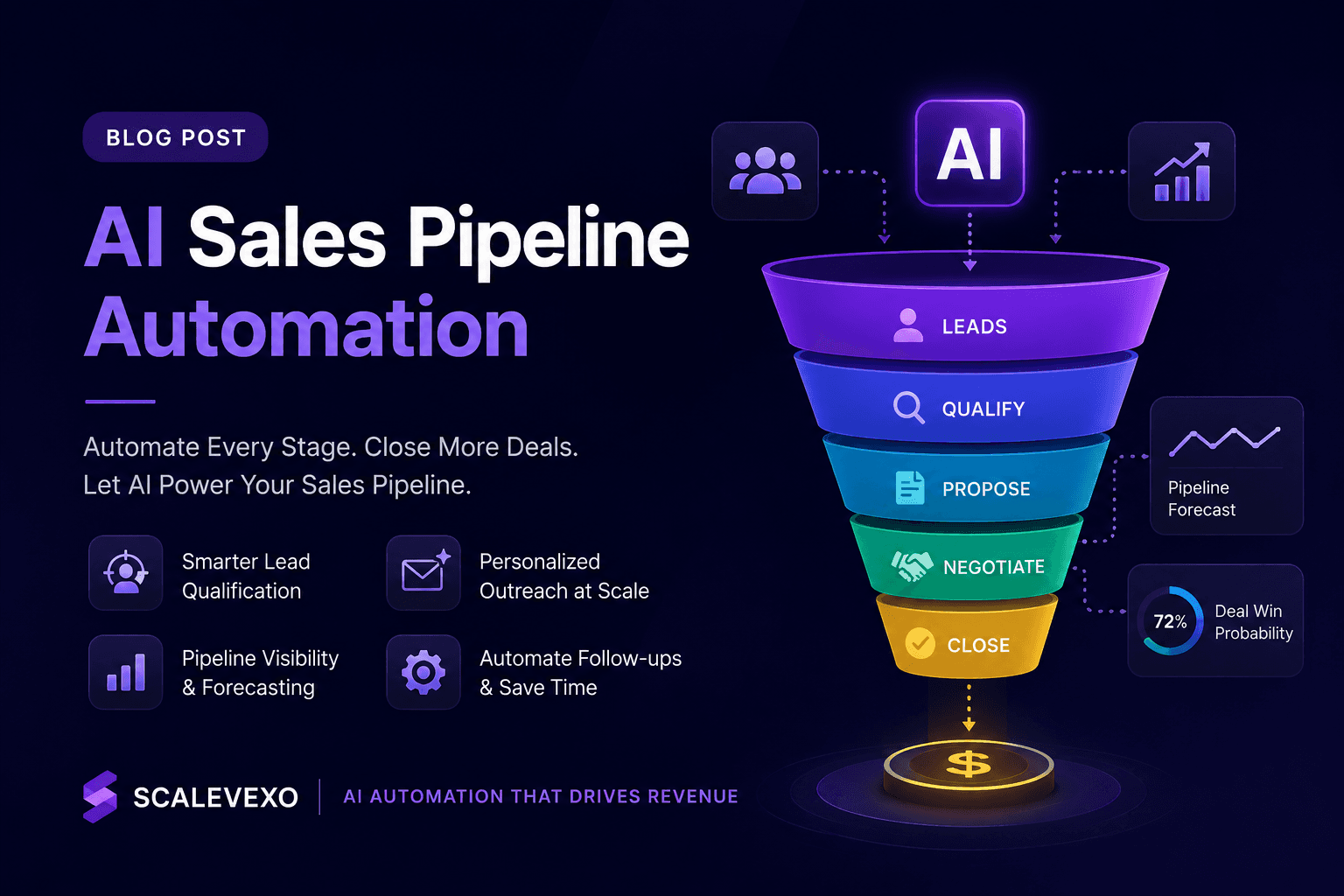
How AI Is Automating Your Entire Sales Pipeline in 2026
Let's start with a number that should bother every business owner reading this.Your sales reps spend only 28% of their time actually selling.The other 72%? It disappears into CRM updates, manual prospect research, follow
Verified by ScaleVexo Engineering Panel|Updated 28 Jul 2026
Let's start with a number that should bother every business owner reading this.
Your sales reps spend only 28% of their time actually selling.
The other 72%? It disappears into CRM updates, manual prospect research, follow-up email drafting, call logging, internal meetings, and chasing down pipeline data that should already be sitting in a dashboard somewhere.
That's not a people problem. It's a systems problem. And in 2026, AI has quietly become the fix that most forward-thinking businesses are already running — while their competitors are still wondering why quota attainment keeps dropping.
This post is about what's actually happening inside modern sales teams right now. What's being automated, what still needs a human, and what your pipeline should look like if you want to stay competitive heading into the back half of 2026.
The Real Cost of a Manual Sales Process
Before we talk about solutions, it's worth being honest about the damage.
Most businesses assume their sales problem is a hiring problem, a lead quality problem, or a closing problem. Rarely do they look at the operational layer sitting underneath all of it.
Sales reps spend an average of 5.5 hours per week on CRM data entry alone — logging calls, updating opportunity stages, cleaning duplicates, generating activity reports. For a team of 10 reps, that's 55 hours every week consumed by work that produces zero revenue. At $100K per rep annually, you're paying roughly $15,000 per rep per year for data entry.
That's not a hidden cost. That's a visible, quantifiable drain.
And it compounds in ways that are easy to miss. Reps who spend two hours a day on admin aren't just losing time — they're making fewer calls, booking fewer meetings, and following up slower on leads that are cooling off while they're busy filling in fields.
Meanwhile, quota miss rates hit 78% in 2026, the worst on record in B2B sales. The math is not complicated. Less selling time equals fewer deals. Fewer deals equals missed targets.
The fix isn't pushing your team harder. It's removing the administrative weight from their workflow entirely.
What "AI Sales Automation" Actually Means in 2026
The phrase gets thrown around a lot, so let's be specific.
Two years ago, AI in sales meant a copywriting assistant bolted onto your email sequence tool. That's not what we're talking about anymore.
In 2026, AI sales automation covers the full stack of non-selling work that used to eat your team's day:
Prospect research and data enrichment — AI platforms like Clay and Apollo pull verified contact data, company details, tech stack information, and buying signals automatically. No more manual LinkedIn digging.
Lead scoring — AI analyzes behavioral signals, engagement patterns, and historical data to rank leads by likelihood to convert. Your reps wake up knowing exactly who to call first.
CRM updates — Calls, emails, and meetings are automatically logged. Opportunity stages update without a rep touching the keyboard.
Follow-up sequencing — Personalized follow-up emails go out at the optimal time, triggered by prospect behavior, without anyone having to schedule or draft them.
Pipeline forecasting — AI models analyze deal health, rep behavior, and seasonal patterns to give leadership accurate revenue predictions — not gut-feeling estimates.
AI SDRs — Autonomous agents that prospect, qualify leads, handle initial outreach, and book meetings before handing a finished opportunity to your human account executive.
The shift is this: AI handles everything that doesn't require a human. The rep's attention is freed for the conversations that actually close deals — discovery calls, demos, complex objection handling, and the relationship-building that turns a first purchase into a long-term account.
The Numbers Behind the Shift
If you're skeptical, the data from 2026 is hard to argue with.
81% of sales teams now use AI in some capacity, up from roughly 50% in 2024. That adoption curve is steep, and the gap between early adopters and late movers is widening fast.
Teams using AI-driven automation are making 23% more calls per day, closing deals 20% faster, and seeing overall efficiency jump by 33% compared to teams without automation.
AI-powered lead scoring alone reduces follow-up time by 60% and increases lead-to-sale conversion rates by 50% by directing sales energy toward high-intent prospects instead of spreading it evenly across every inquiry.
And the return on investment? 86% of sales teams using AI report positive ROI within their first year, with most hitting break-even around month four or five.
The businesses pulling ahead right now are not the ones with the biggest teams or the highest ad budgets. They're the ones that have eliminated the operational friction between lead and revenue.
How a Modern AI-Automated Pipeline Actually Works
Here's what a well-built sales pipeline looks like in 2026, from top to bottom.
Stage 1: Prospecting and Enrichment (Fully Automated)
The old model: a rep spends 45 minutes researching a prospect on LinkedIn, finds their email on Apollo, manually adds them to a sequence, and logs the activity in Salesforce.
The new model: AI identifies prospects matching your Ideal Customer Profile using live signals — recent funding rounds, hiring activity, technology changes, intent data. Contact details are enriched automatically. The prospect is added to the right sequence without a human touching anything.
Signal-personalized outreach built this way achieves reply rates of 15–25%, compared to the 3–5% industry average for standard cold email.
Stage 2: Lead Qualification (AI + Human Handoff)
AI SDRs handle the initial qualification layer — sending outreach, managing replies, asking discovery questions, and triaging responses. When a prospect hits a qualification threshold (positive reply, meeting request, pricing question), it hands off to a human rep with a full context brief already prepared.
The rep walks into every call knowing who they're talking to, what they've read, what they've asked, and where they are in the buying journey. That's a different conversation than one started cold.
Stage 3: CRM Management (Fully Automated)
Every touchpoint — calls, emails, meetings, LinkedIn messages — is automatically captured and logged. The CRM reflects reality, not what a rep remembered to type on Friday afternoon.
Sales teams win back 27% of their time when activity logging is automated. For a 10-person team, that's the capacity equivalent of nearly three additional sellers — without adding headcount.
Stage 4: Follow-Up and Nurturing (Automated with Human Oversight)
Leads that aren't ready yet don't fall off a cliff. AI-driven nurturing sequences keep them engaged with relevant content, triggered by behavior rather than arbitrary time intervals.
Automated nurturing emails generate 4 to 10x more responses than one-off manual blasts. When a prospect re-engages — opens an email, visits the pricing page, clicks a case study — the rep is notified in real time and steps back in at exactly the right moment.
Stage 5: Forecasting and Pipeline Review (AI-Assisted)
Instead of pipeline meetings that turn into guesswork sessions, leadership gets AI-generated forecasts based on deal health scores, historical win rates, rep performance trends, and pipeline velocity. They know which deals are at risk before the quarter ends, not after.
What AI Cannot Replace (And Shouldn't Try To)
This is important, because the businesses that get automation wrong usually make the same mistake: they try to remove humans from everything.
AI-empowered sales teams see 42% higher conversion rates when the technology amplifies human skills rather than replacing human interaction. The key word is amplifies.
There are parts of the sales process where human judgment, emotional intelligence, and relationship quality directly determine the outcome. Complex objection handling. Navigating multi-stakeholder deals. Negotiating contracts. Building the kind of trust that makes a client stay for three years and refer you to two colleagues.
No AI does that well. And the businesses trying to automate those moments are losing deals they should be winning.
The framework that works: AI handles everything that doesn't require a human. Humans handle everything that does. The rep who spends zero time on data entry, research, and scheduling has the mental bandwidth to be fully present in the conversations that matter.
Where to Start: Practical Automation Priorities
If you're reading this and your team is still running largely on manual processes, here's where to start — in order of ROI.
1. CRM automation first. Automating call logging, email capture, and activity tracking gives you back the most time immediately and produces cleaner data for everything downstream. This is the highest-ROI starting point for most teams.
2. Lead scoring next. Once your CRM data is reliable, you can build scoring models that actually reflect reality. Reps stop wasting time on low-intent leads and focus energy where the probability of closing is highest.
3. Follow-up sequences. Build automated nurture flows for leads that aren't ready yet. Stop letting warm prospects go cold because no one had time to follow up on day 7.
4. Prospecting and enrichment. Once the middle and bottom of your pipeline are running cleanly, build the top of funnel automation — signal-based prospecting, auto-enrichment, AI-assisted outreach — to fill it consistently.
5. AI SDR layer. For teams at scale, adding an autonomous SDR layer handles qualification volume without adding headcount. This is the accelerator, not the starting point.
This is exactly the kind of systems architecture we build at ScaleVexo. We map your revenue workflow, identify where the leaks are, and implement automation that works around your existing processes — not against them. See how we approach it →
The Competitive Gap Is Widening
Here's what the data actually shows about where we are in the adoption curve.
In early 2024, 3% of enterprise B2B sales teams were running AI SDRs in production. By Q1 2026, that number was 41%. That's a 38-point jump in 12 months — the steepest single-year adoption gain in any sales technology category since marketing automation in 2014.
The teams that moved early built a compounding advantage. Better data quality, higher conversion rates, faster deal cycles, lower cost per opportunity. Each quarter, the gap between AI-enabled and non-enabled organizations gets harder to close.
The businesses that will struggle in 2027 are not the ones without the best product or the most ambitious targets. They're the ones still spending 72% of their sales team's time on work that a well-configured system would handle automatically.
Related Reading from ScaleVexo
If this post got you thinking about the broader visibility and automation layer for your business, these are worth reading next:
SEO vs AEO vs GEO: What’s the Difference and Which Does Your Business Need? — once your pipeline is automated, you need buyers to actually find you through AI search. This is how.
Our AI Operations Service — how we build automation workflows, CRM integrations, and agentic systems for businesses across the USA, UAE, and Germany.
Final Thought
The sales pipeline is not a strategy problem in most businesses. It's an operational problem. Too much time going into the wrong places, too much manual work slowing down the people who are supposed to be closing.
AI automation in 2026 is not a nice-to-have. For the companies taking it seriously, it's already a competitive moat. For everyone else, it's quickly becoming a liability.
If you want to understand what an automated pipeline would actually look like for your business — not a generic demo, but a workflow built around how you sell — let's talk.
Published by ScaleVexo — AI Operations & Digital Marketing Agency serving businesses in the USA, UAE, Dubai, and Germany. Last Updated: July 2026
Frequently Asked Questions
What is AI sales pipeline automation?
I sales pipeline automation is the use of artificial intelligence and automated workflows to handle the non-selling tasks in a sales process — including prospect research, lead scoring, CRM updates, follow-up sequencing, and pipeline forecasting. The goal is to free sales reps to spend more time in revenue-generating conversations by removing administrative overhead from their workflow.
How much time do sales reps actually spend selling?
According to multiple 2026 studies including Salesforce's State of Sales report, sales reps spend only 28–30% of their working time on actual selling. The remaining 70–72% is consumed by CRM data entry, manual research, internal meetings, follow-up coordination, and administrative tasks — most of which is fully automatable.
What parts of the sales process can AI automate?
AI can reliably automate prospect research and data enrichment, lead scoring, CRM activity logging, follow-up email sequencing, initial outreach, meeting scheduling, and pipeline forecasting. It can also handle early-stage qualification through AI SDR agents that prospect and qualify leads before handing off to human reps.
What parts of sales should stay human?
Complex objection handling, multi-stakeholder deal navigation, contract negotiation, relationship-building, and high-stakes discovery conversations should remain human-led. These are the areas where emotional intelligence, trust, and judgment directly influence the outcome in ways AI cannot replicate reliably.
How long does it take to see ROI from sales automation?
Most teams see productivity improvements within 30–60 days as administrative overhead drops. Revenue metrics like conversion rate and deal velocity typically improve within 90–120 days as cleaner data and better lead prioritization flow through the pipeline. 86% of sales teams using AI report positive ROI within their first year.
Where should a business start with sales automation?
Start with CRM automation — automating activity logging, call capture, and email sync. This produces immediate time savings and creates reliable data for everything built on top of it. Lead scoring, follow-up sequencing, and prospecting automation are the logical next layers, in that order